
Las piezas de fundición a presión del disipador de calor son diferentes de las cubiertas normales. Su geometría debe soportar tanto el montaje mecánico como la transferencia de calor. Un pequeño cambio en el grosor de las aletas o en la planitud de la base puede afectar el rendimiento.
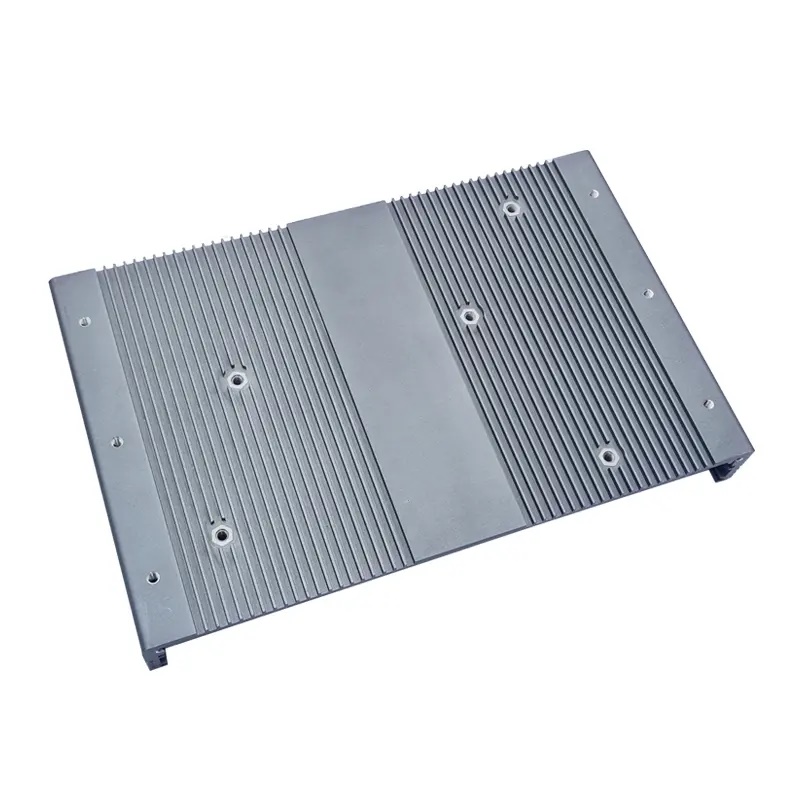
| Característica | Por qué es importante | Método de inspección |
|---|---|---|
| Superficie base | contacto térmico y montaje | planitud y control visual |
| Aletas | área de disipación de calor | apariencia y plenitud |
| Orificios de montaje | fijación de placa o módulo | control de posición y hilo |
| Acabado superficial | protección y apariencia | revisión de recubrimiento o desbarbado |
Producto relacionado:placa de disipador de calor de fundición a presión de aluminio. Capacidad relacionada:servicio de fundición a presión de aluminio.
El rendimiento térmico de un disipador de calor fundido a presión está influenciado por el área de las aletas, el espesor de la base, la presión de montaje y el contacto de la superficie. Un disipador de calor visualmente atractivo aún puede funcionar mal si la superficie de contacto no es plana o si el recubrimiento bloquea la interfaz térmica.
| Característica de diseño | Beneficio | Preocupación por la fabricación |
|---|---|---|
| aletas altas y delgadas | más superficie | llenado y expulsión más duros |
| base gruesa | mejor estructura | control de contracción y enfriamiento |
| superficie de contacto mecanizada | mejor contacto del módulo | agrega operación CNC |
| superficie pintada | apariencia y protección | Evite recubrir la cara térmica crítica. |
Para las piezas del disipador de calor, es mejor involucrar al proveedor de fundición a presión antes de congelar el diseño. El proveedor puede revisar el espesor de las aletas, el tiro, la expulsión, los márgenes de mecanizado y el método de inspección antes de comprometer el costo de las herramientas.
Un disipador de calor puede tener una apariencia de pintura limpia pero aun así funcionar mal si la superficie de contacto térmico es desigual o está revestida incorrectamente. La superficie que toca un módulo LED, PCB o componente de alimentación debe tratarse como una superficie funcional. Si se requiere planitud, se debe mecanizar e inspeccionar. Si se aplica un recubrimiento, el comprador debe confirmar si la superficie de contacto permanece sin recubrimiento.
Las aletas delgadas aumentan la superficie, pero también dificultan el llenado y la expulsión. Una base muy gruesa mejora la rigidez pero puede crear riesgo de contracción. El mejor diseño equilibra el rendimiento térmico con la moldeabilidad. Cuando los compradores proporcionan sólo un modelo 3D terminado sin prioridades de rendimiento, el proveedor no puede saber qué características se pueden ajustar y cuáles se pueden arreglar.
| Característica térmica | Preocupación por la fabricación | nota del comprador |
|---|---|---|
| aleta delgada | llenado y daños durante la expulsión | confirmar el espesor mínimo aceptable |
| base mecanizada | añade tiempo CNC | marque la planitud y la rugosidad si es necesario |
| revestimiento | puede afectar el contacto térmico | definir zonas sin recubrimiento |
Teléfono:+86 18868921505
Correo electrónico:lijianguo@cxhuabo.com
Dirección: Y iheng road, ciudad de Changhe, ciudad de CI, ningbo, provincia de Zhejiang, China

escanear wechat
Copyright © 2022 Cixi Huabo Machinery Co., Ltd
Mapa del sitioEste sitio web utiliza cookies para garantizar que obtenga la mejor experiencia en nuestro sitio web.

 English
 Pусский
 Français
 日本語
日本語



 Whatsapp
 Teléfono
Comentario
(0)